Colour blindness is one of the world’s most common genetic (inherited) conditions, which means it is usually passed down from your parents.
Red/green colour blindness is passed from mother to son on the 23rd chromosome, which is known as the sex chromosome because it also determines your sex. Chromosomes are structures which contain genes, which give the instructions for the development of cells, tissues and organs. If you are colour blind it means the instructions for the development of your cone cells are different to those for people who have ‘normal’ colour vision. This can result in one cone cell type either being missing, or less sensitive to light, leading to incorrect information via ‘faulty’ electrical signals going from your cone cells to your brain.
Blue/yellow inherited colour vision deficiency genes are not carried on the X-chromosome. This condition is not inherited in the same way as red/green types of colour blindness and is extremely rare in comparison.
For the sake of simplicity we refer to a colour blind ‘gene’ but this is not strictly a true description. Red and green types of CVD are actually caused by different genetic code sequences to those for normal colour vision. The genetic code sequence you have will determine which type and severity of (red or green) colour blindness you have (or if you have normal colour vision).
The 23rd chromosome (pair) is made up of two parts – either two X chromosomes if you are female or an X and a Y chromosome if you are male. The ‘gene’ which causes (inherited, red and green types of) colour blindness is found only on the X chromosome. So, for a male to be colour blind the colour blindness ‘gene’ only has to appear on his X chromosome. For a female to be colour blind she must have colour blindness ‘genes’ present on both of her X chromosomes.
Table 1
A colour blind man and a non-colour blind woman
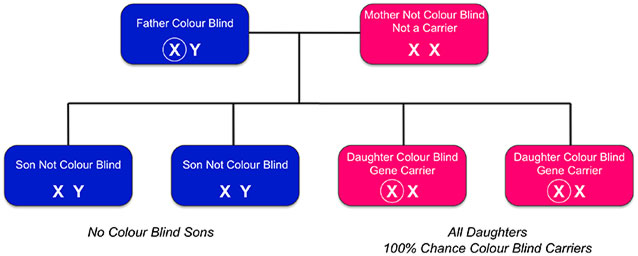
If a woman has only one colour blind ‘gene’ she is known as a ‘carrier’ but she won’t be colour blind. When she has a child she will give one of her X chromosomes to the child. If she gives the X chromosome with the colour blindness ‘gene’ to her son he will be colour blind, but if he receives the X chromosome which doesn’t carry the colour blindness ‘gene’, he won’t be colour blind.
A red/green colour blind boy can’t receive a colour blind ‘gene’ from his father, even if his father is colour blind, because his father can only pass an X chromosome to his daughters.
A red/green colour blind daughter therefore must have a father who is colour blind and a mother who is a carrier (and who has also passed the colour blindness ‘gene’ to her). If her father is not colour blind, a ‘carrier’ daughter won’t be red/green colour blind. A daughter can become a carrier in one of two ways – she can acquire the ‘gene’ from a carrier mother or from a colour blind father.
This is why red/green colour blindness is far more common in men than women.
Blue/yellow colour blindness affects both men and women equally, because it is carried on a non-sex chromosome.
For the sake of the following explanation a normal X chromosome is shown as (X) whilst a colour blind carrying X chromosome is shown in bold (X).
The colour blind ‘gene’ is carried on one of the X chromosomes. Since men have only one X chromosome, if a man’s X chromosome carries the colour blind ‘gene’ (X) he will be colour blind (XY). A woman can have either:-
(i) two normal X chromosomes, so that she will not be colour blind or be a carrier (XX),
(ii) or, one normal X and one colour blind carrying X chromosome, in which case she will be a carrier (XX), or rarely
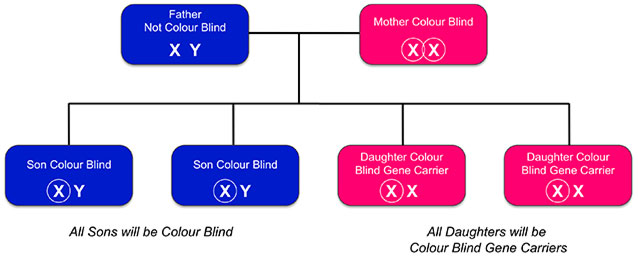
(iii) she will inherit a colour blind X from her father and a colour blind X from her mother and be colour blind herself (XX). She will pass on colour blindness to all of her sons if this is the case. All of her daughters will be carriers.
See the tables below to understand how people can become colour blind and how colour blindness is passed on to future generations.
Table 2
A non colour blind man and a colour blind carrier woman
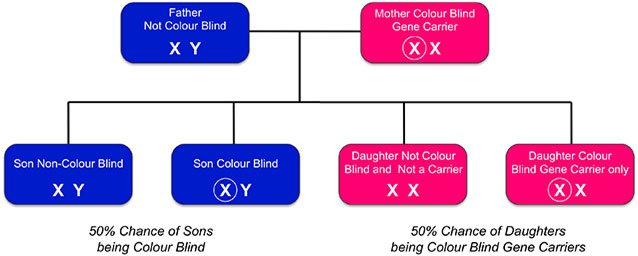
Table 3
A colour blind man and a colour blind carrier woman
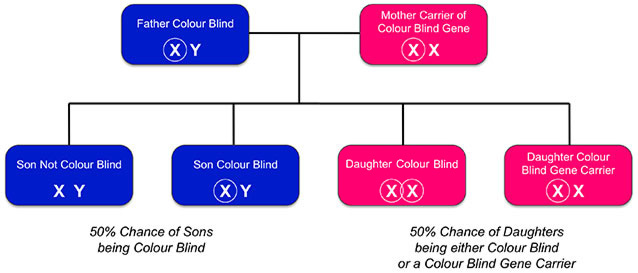
Table 4
A non colour blind man and a colour blind woman